
Do you have kiddos that need to move? My room is full of kiddos who crave movement. Research is very clear… movement is good for our brains. Movement helps our brains learn new skills better. It keeps our sensory systems alert.
While that sounds wonderful, it can also make special education teachers nervous to incorporate movement. Our students tend to be more impulsive, less organized, and quicker to get off task. But… it is possible to do it well! Read on for some easy-to-implement ideas for combining motor movement and math skills.

Tips for combining math and movement
Consider these essential questions when planning for motor math activities.
- Which math skills am I targeting? Does it have to be differentiated?
- Which motor tasks fit well with the math skill?
- What materials will I need?
- Where will I store the materials?
- How will I limit wait time?
- Will students need an adult to complete the motor math activities?
Once you have answered these questions, you are on your way to putting the motor math activity into place. Be sure to teach students (and possibly staff) how to do the activity, the expectations, and how to use any materials.
You should also use parts of the IEPs to design and set up this activity. Read about how to use IEPs to set up centers HERE.
Use the following examples to get you started.
motor math example 1
This math center was all about adding. I wanted to give my students a different way to practice adding while incorporating movement. This group of students was also working on jumping with two feet together in PT, so that’s the movement I chose for this center.
My students have fine motor delays, so I chose over-sized die for our materials along with a whiteboard and dry-erase markers.
First, students had to pick up the dice and jump through the hopscotch-like circles to get to the table. Once at the table, students rolled the die.

Next, the student counts the dots and then writes the number on the whiteboard. If students are not yet able to write, an adult or peer can do the writing. Then, have the student roll and count the dots again for the second number in the addition sentence. Finally, have students add the two numbers together.

Together we made groups of dots under the numbers to practice making sets and developed a visual for the addition sentences. Once the addition sentence was completed, the students jumped the sentence out with the hopscotch rings. For example, for the addition sentence of 3 + 2 = 5, the student jumps three times. Then, the student adds 2 by jumping two more.
Motor movement Math Center Example 2
This center combines subtraction and bowling. I chose bowling because it incorporates motor skills my students are working on in PT and in P.E. class. It’s also a good hobby or leisure skill for students to learn.
For this center, students started by setting up bowling pins and counting how many there were (10). That number was written on the chalkboard.
Next, the student bowled and tried to knock down as many pins as possible. Students then counted how many pins were knocked down.


3rd math motor center
The 3rd center was Stamping Up The Sets. Students had to draw a number, identify it and then stamp that many. For this center, the focus is on fine motor movements. Students have to roll a die and make a set that matches that number by stamping that many times.
We then kept the learning going with these winter math interactive books. There are 3 different types of books included, so I can use them with all of my students. We reviewed making sets with these books:
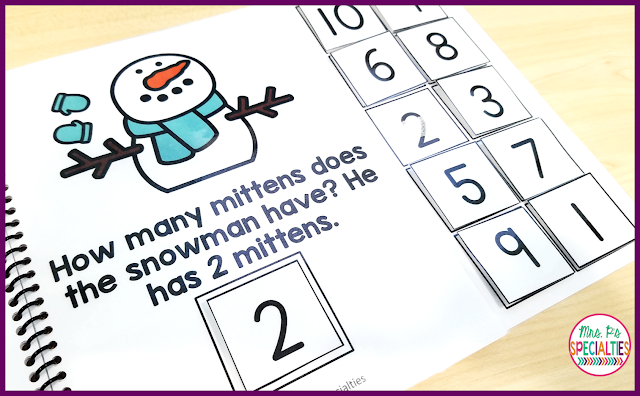
We worked on generalizing addition skills: 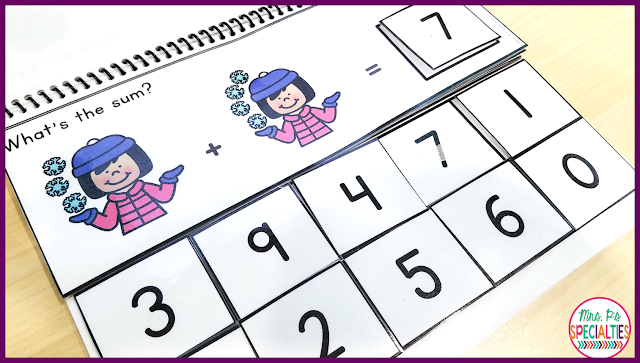
This book was to review subtraction: 
Want to learn more ideas and tips for getting students moving?
Read: Put Research Into Practice By Building In Movement.
Need hands on math materials that are already leveled and contain visual supports? Click the picture of button below to see all of the math units that have been designed to save YOU time and energy while easily meeting your students’ needs.


