Small group instruction can be powerful and useful in special education programs. Guided math is a great way of structuring math instruction in a small group. While many of our students learn best in 1:1 settings, being able to work in a small group setting is a critical lifelong skill to build. Students who go on to hold jobs or volunteer in the community, need to be able to function within a group.

Guided math is a way of structuring math instruction in a small group. I know what you are thinking…. My students don’t learn well in a group setting!
Don’t worry… I thought the same thing at first. I’ve seen the difference and it’s worth the effort. It does take a bit of adjusting, but keep with it!
Do our students learn best in 1:1 settings? Yes. BUT that doesn’t mean there isn’t value in small group instruction. As I mentioned in the beginning, our students need to be able to work in small groups in the community. This is a great way to integrate academics and build functional skills.
Here are some tips on making it work in the special education setting.
HANDS ON LEARNING IN GROUP INSTRUCTION
My students are hands on learners. They need a TON of practice and repetition in order to learn and then generalize the skills across materials, settings, and people.
These
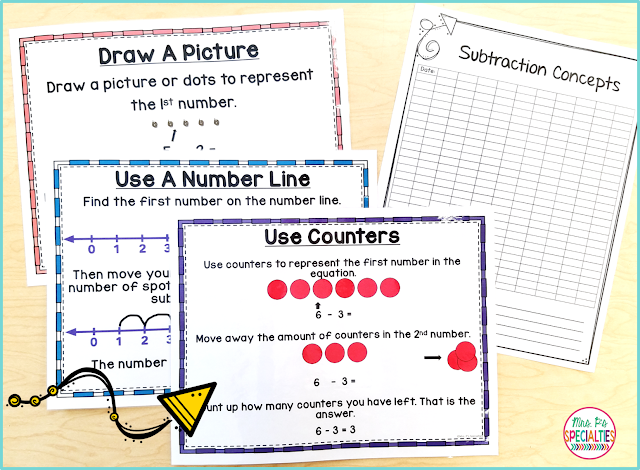
math units are ideal for hands on learners because they already include visual supports and hands on practice. Once we have finished using the materials in instruction, we use the materials in math centers and
task boxes. This helps teach students to generalize their skills.
Once you have the materials and resources you will be using, it is time to decide on your groupings. For my class, I like to do groups of 3. If your students don’t have any experience with small group instruction, then you might want to start with a group or 2 and build up to 3 as students make progress. I also have a para support the group because my students need a high level of feedback and support.
If you don’t have paras in your classroom, you could try having an older student help (think reverse mainstreaming) or have a therapist join the group. Math involves a lot of language, so speech therapists are always a good choice.
At first, we use the worksheets included in the subtraction unit to practice the strategies going step by step. We read the subtraction sentence aloud as a group. This allows me to hear how the students label the parts of the equation.
For example, as we read out the first problem, I noticed that one of my students was calling the minus sign McDonalds! Guess what… that didn’t make sense to him and neither did subtraction!
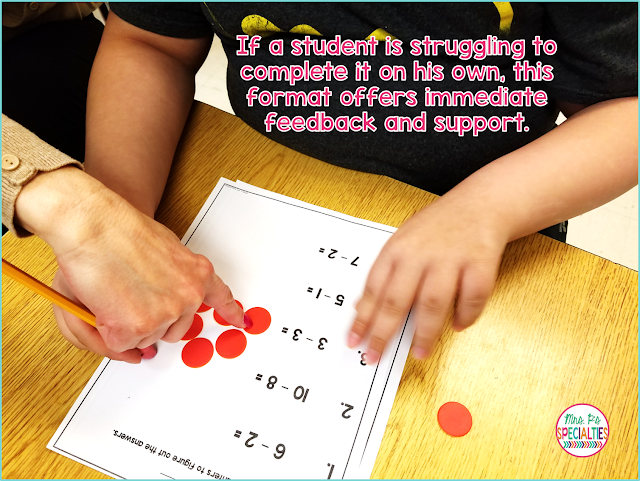
Once I corrected it and told him it was the “take away” symbol, he began understanding the concept of subtraction. Even though we are instructing in small groups, I still can give feedback right away to students.
Next, we use manipulatives to figure out the answer. Using manipulatives also helps students create a visual of the problem.
Once we have finished the worksheet as a group, we go through and read the completed subtraction problems as a group. This step has helped my students with fluency in reading the problems and with remembering the math facts. To be truly functional in subtraction, students need to know subtraction facts quickly.
INDEPENDENT PRACTICE IN SMALL GROUPS
The next step is to allow students to practice what we did on their own. We are still in the small group instruction setting, but now each student is given a new worksheet that follows the same format & told to complete it. This is a great time for the para and me to assess if the students understood the lesson and can apply it. This format is perfect because it allows us to give the students immediate feedback and support.
Our students easily fall into routines and can be inflexible. Our students must have access to correction and 1:1 support if they aren’t understanding, have something wrong, or can’t apply the lesson. Having 3 students and 2 staff during this time allows us the ability to do the correction and give a high level of feedback. For us, this is also the perfect ratio for helping students move from 1:1 instruction to small group instruction.
Read more about different types of instruction: